
Key Takeaways
- The term “AI share of voice” refers to the part of all generated answers within a certain category that consists of mentions of your brand as opposed to those of your competitors.
- For a fair score, you also want to make sure the brand is described fairly in the answers in which it does appear.
- Run the same set of prompts on a fixed schedule so you can track progress over time and really understand what’s happening.
Introduction
You ask ChatGPT for the best tool in your category, and none of your brand names appear – your competitor just got a free plug. In this guide, we look at the features of AI share of voice, which helps to measure that gap and provide you with tools to monitor AI brand mentions in your categories without spending too much time on it.
What Is AI Share of Voice?
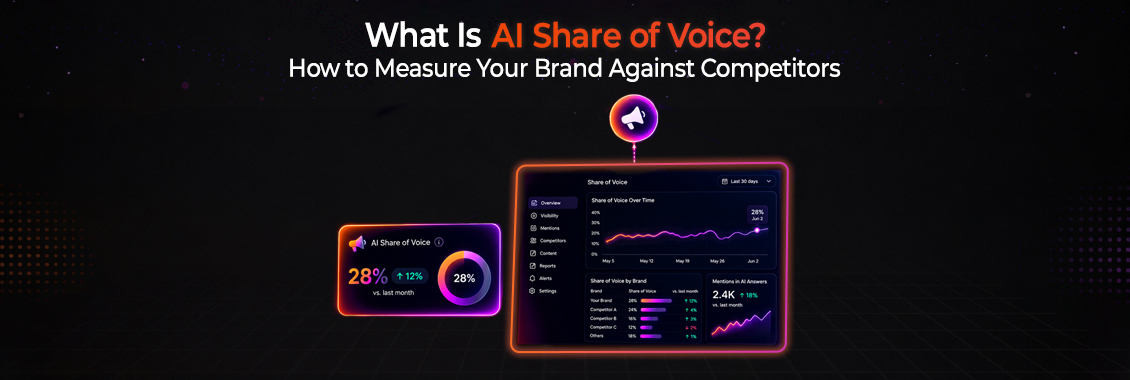
The “share of voice” of AI in your category refers to the proportion of all the conversations with AI in your category in which your brand is mentioned versus your competitors. It’s like conventional market share but for conversations with AI.
Note that unlike classic share of voice (i.e., ads, rankings, social media chatter), the AI share of voice is limited to brand mentions in AI-generated answers to buyer questions. In other words, an AI share of voice measurement consists of all the AI brand mentions of a brand in a category, divided by the total number of brands mentioning in that same category of answers.
Simply take the number of your brand mentions and divide this by the total number of brand mentions found in the chat answers. Then multiply by 100%. To receive reliable results, always use the same set of input prompts for the analysis.
Why It Matters Right Now?
A brand not listed in the first few names of a shortlist has little chance of seeing the inside of that buyer’s home.
Typical analytics don’t account for this type of conversation, as there is no visit generated by the conversation where the brand of a competitor is mentioned. However, by tracking AI brand mentions, an AI mention tracker can track and provide a fair report on the data.
This also enables you to measure the effect of updates on your content and of changes to your web pages. Don’t be fooled into only analyzing your own brand name. Analyze your competitors as well, as the results can change very quickly.
The Three Checks Behind a Fair Score
The three areas of a fair AI share of voice score are presence, position, and perception.
Presence: Presence is the simplest of the three checks: does your brand name appear in AI-generated answers at all?
Position: A mention of first rank is far more valuable than one last rank, since most readers of lists of that sort tend to read only the top items and then skip to the bottom for a quick glance comparison of end points.
Perception: Negative mentions of a brand (e.g. “Great price but terrible support”) should also be counted as less than fully positive. Note whether AI-generated text contains primarily positive language, neutral language, or negative language about your brand.
| Check | What to Record |
| Presence | Whether you are named, counting every one of your AI brand mentions |
| Position | Where you sit in the list |
| Perception | The tone around your name |
| Platform | Which AI tool gave the answer |
How to Measure Your AI Share of Voice Step by Step?
Measuring your ROI online can be very simple. There are 5 steps to online ROI measurements that are common practice. Building a prompt list for your questions, deciding who your online competitors are, using online search to get answers to your questions online, scoring the results of your questions, and comparing your results online.
Step 1: Build a Prompt List
The questions you would like to have answered by potential customers can be written in five minutes. This includes questions like “best tool for…”, comparisons between different alternatives, as well as straightforward problems that your customers are facing. Make sure to exclude questions that already contain your brand name. This is because such questions are – by definition – not interesting to you.
Step 2: Pick Your Competitors
It’s crucial to choose your competitors based on how the AI has answered previous prompts by the organization, not based on what the sales team perceives to be the competition for the organization. There can be surprise competitors listed by the AI as well as review sites.
Step 3: Run Prompts Across Platforms
Use the following AI search tools: ChatGPT, Gemini, Perplexity, and Google AI Overviews (such as Google AI Overviews for shopping search). Remember to score each individual answer separately. Run each prompt several times, as the answers will change with each run.
Step 4: Score Every Answer
For each Answer to a Question by an AI About Buyers to Buy Your Type of Product or Service, record in a Spreadsheet the Number of Mentions of Your Brand Name, the Position in which your Brand Name appeared, and the Perception by potential buyers of you and your competitors in that position.
Step 5: Calculate and Compare
Now multiply that number by 100 and add up the result for each platform to arrive at your final score for that topic. It may be surprising, but the overall score can sometimes hide a dramatically underperforming single platform and thus actually indicate the fastest winning strategy.
Manual Checks vs AI Mention Tracking Tools
While manual checks can provide initial insight, tracking mentions manually is not sustainable once the list of prompts exceeds a few dozen. The answers change on a daily basis, and organizing the results in a spreadsheet becomes a burden in itself that no one wants to deal with on a weekly basis.
Proper AI tracking of mentions allows for tracking changes in mentions over time. Ideally, you want to track all changes of all your runs of previous questions (i.e., all previous analysis) as well as changes of new runs of the same question. A good AI tracking tool for mentions will also notify you when you have been surpassed by a competitor.
Do you want to get a feel for how your brand is currently performing across the main AI platforms before you create a spreadsheet to track your results? Check Your Brand’s AI Visibility.
How to Read Your Results?
Look at your number first by platform and then by topic. A platform for which you score poorly versus others will likely be one for which a source that you rely upon is not included in their answer set.
Next, list out the questions where your competitors are mentioned, but you are not. Write out the first line of a new page for each of these questions.
Look at where the AI has learned about your category. Review sites, industry roundups, forums, and the blogs of experts in your industry all get referenced in AI answers. Identify where your rivals are listed that you are not, and ask for inclusion or write content that merits inclusion in relevant sources.
Finally, read the tone of the AI’s answers. If the AI is continually referencing the same problem with your brand, fix the problem and update the corresponding pages and respond to reviews with proof of the change. The AI mention tracking will then show the positive change in the share of voice over time.
Start Measuring What AI Says About You
Analyzing share of voice using AI-powered brand mention tracking helps to identify who is having the best conversations that your website or social media analytics cannot. That’s where MentionPilot comes in – a web-based AI-powered tracking tool for AI brand mentions.
It supports tracking brand mentions across ChatGPT, Gemini, Perplexity, and Google AI from within one dashboard. Alert you the moment your tracking query picks up a new mention, shows you how the AI saw it, even scores it for positivity, and much more. Try it today and see how you rate against your competitors for your AI brand mentions.
Time to see your true share of voice! Start tracking your brand today.
Start Tracking With MentionPilot!