
Key Takeaways
- AI visibility should be measured across mentions, citations, sentiment, competitor share, and the prompts that matter to your clients.
- A single score is useful to provide a quick snapshot, but you will find the answer to what you can improve by looking at the answer behind the score.
- Connect changes in AI visibility to content, brand positioning, and relevant SaaS business outcomes, and don’t just present a mass of figures in a report.
Introduction
AI search has changed the question agencies hear from SaaS clients. It is no longer only, “Where do we rank on Google?” Clients now want to know, “What does ChatGPT say about us?” and “Are we showing up when buyers ask AI for software recommendations?
When measuring visibility in AI search for your SaaS clients, don’t fall into the trap of tracking everything while measuring nothing. Therefore, SaaS agencies should focus on measuring a small set of meaningful metrics in AI Search Visibility Tracking for SaaS Agencies.
What Should SaaS Agencies Measure In AI Search?
For SaaS agencies, it’s important to track brand mentions (including citations), position, sentiment, share of voice, prompt-level visibility, and changes over time.
One simple SaaS buyer question is: “What are the best project management tools for remote teams?”
The appearance of your client’s brand in an answer to a buyer’s question is important, but you also need to know whether the brand was recommended, where it was mentioned (e.g., in the answer to the question, in the description, etc.), what AI source was used to generate the answer, and whether competitors appeared before the client’s brand.
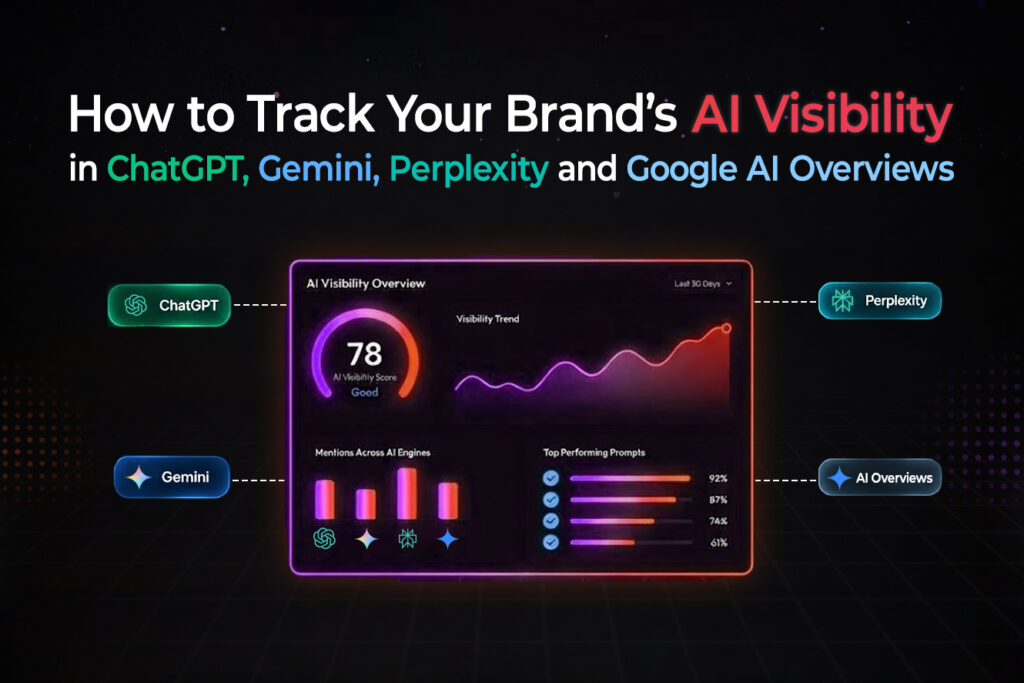
So, instead of just displaying a number, an AI mention tracker should display the full context of the prompt and response. Here’s a great example of such a tool, called MentionPilot, which tracks: the prompts themselves, mentions, citations, competitors, sentiment, and visibility across AI platforms like ChatGPT, Gemini, Perplexity, and Google AI Overviews.
-
Track Mentions, But Look Beyond the Count
A mention is an occurrence where an AI search result contains a reference to the brand name of your client. Whether this is good or not can vary greatly.
The bigger problem is then that the count is reported without any context.
Was the brand name mentioned positively as one of the options?
- Was the brand name mentioned as one of many other tools?
- Was the brand name mentioned after a competitor?
- Is there another category where the SaaS company wants to get more recognition?
With an AI mention tracker, such as MentionPilot, you can look at the underlying prompt and the full AI response. This way, your team can easily see what happened to influence the numbers and comment accordingly in your report to your client.
-
Measure Citations Separately From Mentions
Mentions and citations are different signals.
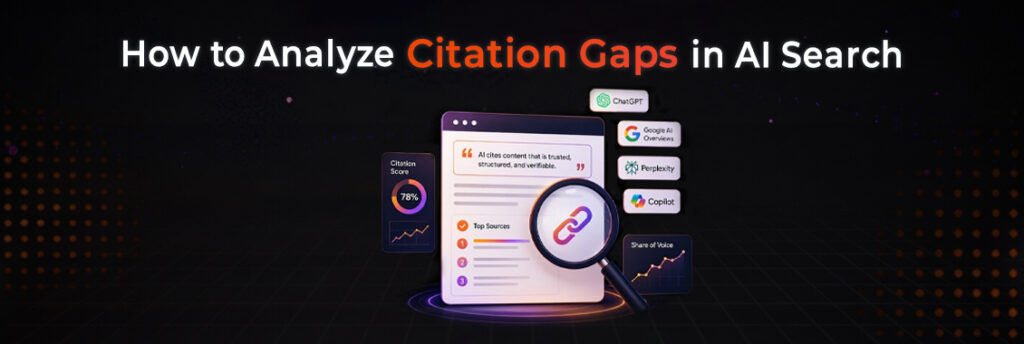
This distinction highlights an important factor to track: citations. If a brand is being mentioned by AI systems, it’s also very important to know if the system is referencing sources and pages to support the answer given. Search Engine Journal goes in depth on this point as well and outlines cases where a brand is being mentioned by an AI system but receives no citations, and cases where a brand or content source is being cited by an AI system but receives no mention of the brand itself.
For SaaS agencies, this can translate into the following useful content questions for SaaS agencies:
What pages? What third-party sources is AI using to develop an understanding of your SaaS client?
If AI generates frequent citations to a review site, to a comparison page, to a community, or to a particular product page of the SaaS client, then analyzing that source for potential content or reputation gaps is extremely valuable as it typically goes unseen when utilizing traditional rank tracking methodologies.
-
Watch Share Of Voice Against Competitors
Add contrast to your visibility.
This would reveal, for example, that for buyer prompts related to your SaaS client and their direct competitors, your client is most often mentioned, is most frequently recommended, and appears most often overall in responses to these prompts.
This will also make the competitor’s analysis so much more useful, as you will be able to show them where the competitor is appearing for the client’s specific buyer prompts and what questions create the gap in visibility.
-
Track Sentiment And Brand Positioning
As visibility of your content is transmitted via AI-generated answers, it’s also important to verify that the content, and thus the brand, is correctly represented.
Similarly, you need to track how AI is talking about a brand (in a positive, neutral, or negative light) and also how AI is positioning your brand in the market for certain features or services.
For example, if a SaaS enterprise focuses on securing the enterprise, but most of the relevant visibility is generated from mentions of it as “cheap for small businesses”, then the visibility is not favorable.
MentionPilot already integrates sentiment monitoring for brand mentions. In the AI-generated answers, SaaS companies can now also see the tone of the customer!
Note that these labels are the starting point for your analysis, and the actual word choices in the brand mentions will likely be much more telling than the labels assigned.
-
Measure Visibility By Prompt, Not Just By Platform
Platform-level reporting can hide useful details.
Just because visibility is strong on ChatGPT, for example, does not mean that all relevant buyer questions are covered. Tracking visibility on a per-prompt basis (grouped by relevant intent categories) is far more relevant to SaaS clients.
For example:
- Category questions
- Product comparisons
- Alternative searches
- Pricing questions
- Feature-specific searches
- Problem-based questions
- Branded questions
You can track visibility changes and link them to specific prompts with an AI mention tracker.
This also helps to create a basis for reporting. For example, a client who is highly visible for branded questions but less visible for category questions is clearly a content and positioning issue waiting to happen.
-
Compare AI Engines Instead Of Blending Everything
As AI solutions continue to evolve, it’s also important to recognize that answers generated from different AI solutions can sometimes differ from one another. So, be sure to treat all solutions uniquely within your plans and track them separately as well.
Adobe suggests looking at brand presence across multiple AI-powered search experiences (even within the same AI engine), including visibility in ChatGPT, Gemini, Perplexity, and Google AI Overviews for those clients where they are a factor. Visibility into search experiences powered by AI measures visibility in generated answers for search experiences, not traditional search result position.
This will ensure that the blending does not mask a weakness in one of the areas measured.
-
Do Not Stop At The Visibility Score
Visibility scores make great dashboard headlines. But reports are for more than headlines.
The authors of Search Engine Journal make a similar point about score changes, not always translating to meaningful activity for a business. That is why they develop the rest of the report to describe the appropriate action steps for marketers around changes in score.
For an agency, the useful workflow is simple:
Score changes → inspect prompts → inspect answers → identify sources → make a content or brand action.
That turns reporting into strategy.
What Should Agencies Look For In The Best AI Visibility Tools?
Raw AI answers should be easily understood by your agency, not hidden behind a single score in a dashboard.
Before choosing a platform, check whether it can:
- Track the AI platforms your clients care about.
- Save and monitor relevant prompts.
- Separate mentions from citations.
- Show competitor visibility.
- Track sentiment or brand framing.
- Let your team inspect the actual AI responses.
- Create reports clients can understand.
Also important is how the chosen tool will enable your team to move from a given metric to corresponding action. A drop in visibility does not necessarily mean that negative results for your client have been found, but your team will most likely have to engage in a lot of manual work in order to find the relevant information.
We built MentionPilot around this workflow – it enables you to track your prompts, analyze competitors, track citations, check the sentiment, monitor AI visibility, and more – all in one dashboard.
How Should SaaS Agencies Report AI Visibility To Clients?
Keep it simple.
A useful monthly client report can include:
- Overall visibility movement
- Visibility by AI platform
- Top prompts where the brand appears
- Prompts where competitors appear instead
- Important citations and sources
- Sentiment or positioning changes
- Recommended actions for the next reporting period
There are many AI-powered visibility tools available in the market to enable agencies to track visibility more easily. However, ultimately it is the agency’s responsibility to make sense of the data to tell a story and identify necessary actions for the client.
Don’t let the complex scorecard be confusing for your client. Outline the changes, possible reasons, and activities that have to be tested in the following reporting period.
How To Turn AI Visibility Data Into SEO Actions?
For repeat category prompts, look at the content behind the AI-generated answers. If a competitor is repeatedly seen in answers, review the content surrounding their product offerings. If the client’s product is seen but incorrectly described, find out what pages on their website and third-party sources are causing the incorrect description.
Once you have pinpointed the area for which your competitor is ranking highly, look at the corresponding Content related to that Prompt and check any Sources cited within the answers. If the Brand appears but is incorrectly described, look at the corresponding Page(s) and any Third-Party references.
This is where an AI Mention Tracker is integrated into your agency workflow instead of just another reporting tool.
You find the gap, you try to understand why the AI doesn’t mention your client, you fix the issue, and then you track the same prompt set again.